I spoke last Sunday, Sept. 10, 2023, at Hudson Valley Books for Humanity about my memoir, to a small but passionate audience that included Steven Goldberg, the director of education at the Holocaust & Human Rights Education Center of New York.
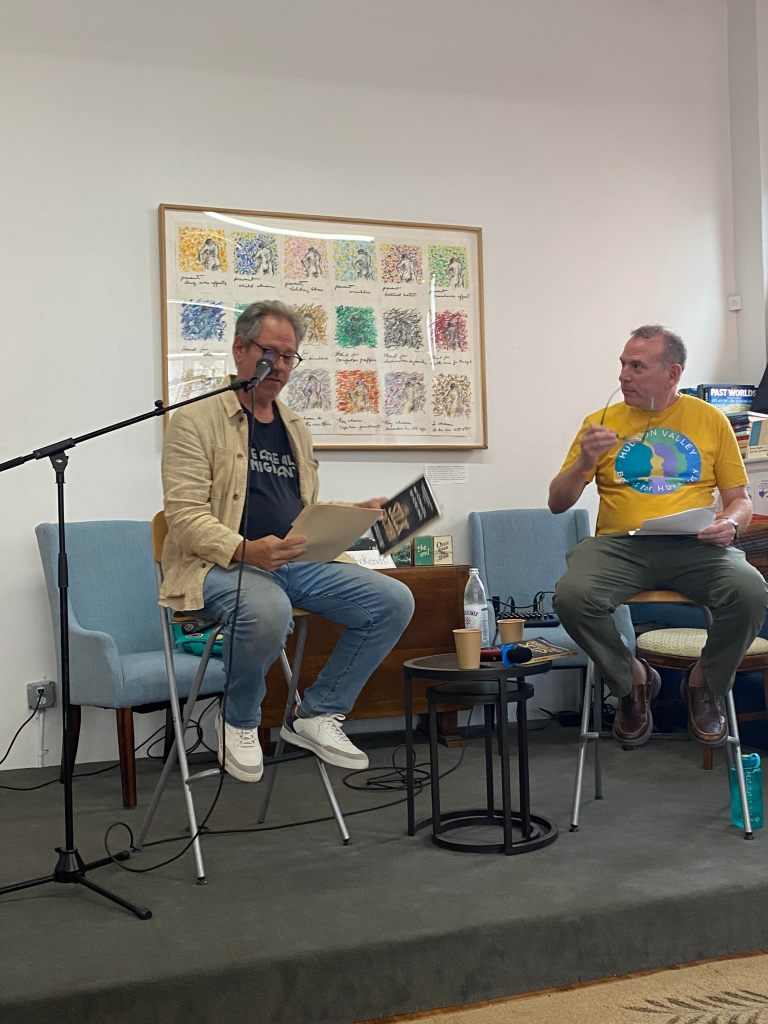
I think it’s worth publishing the text of what I said because it encapsulates a lot of what I think about with regards to this memoir:
Hi, my name is Michael Hickins and I’m the author of The Silk Factory: Finding Threads of My Family’s True Holocaust Story. I was born in Queens, NY to a German-Jewish father who changed his name from Hirschkind to Hickins, and a Russian Jewish mother named viviane bronstein. I have three children, the eldest of whom is 33 and lives in France, where I lived for about a dozen years, and the youngest of whom is now 7 but was 3 at the time this story takes place.
I guess I’ll start by saying that having been born in 1961, it might seem a bit odd for me to be writing a Holocaust memoir, as I was born some 20 years after the fact.
As a former journalist and to this day a writer of short fiction and novels, writing about the Holocaust was not something I had planned on doing.
Like for many people, I suppose, the Holocaust was a thing that happened a long time ago, to other people, some of whom might have been members of my family. It’s not that I minimized what it was, or the importance it played in the history of the Jews, in European history, American history, and the history of Israel – but it was history.
It didn’t seem especially relevant to me, to now.
And then I received an email – from someone I didn’t know existed – that started me off on a journey that I felt was important and universal enough for me to put other things aside and write about it, and share it with you.
So what I’m going to do for the next ten or so minutes is give you a bit of background, read the very short opening section, after which I’m going to be joined by Eric Katz, and he and any of you who wish can ask me questions and we can have a conversation.
So the first thing I want to mention is that the title of my memoir references a silk factory.
Growing up, I had been told that at some point, my father’s family had owned a silk factory in the little town where he was born and lived – called Ansbach, in Bavaria, Germany. I also knew that the Nazis had passed laws – the Nuremburg Laws — prohibiting Jews from owning or running businesses, and that my family had signed the factory over to my father’s sister’s husband, a gentile by the name of Reinhold Lutz, whose name she carried as long as she lived, even though they had divorced – again, I was told, in order to comply with the Nuremburg Laws. And, finally, I had been told, after the war, it turned out that the good Dr. Lutz – he had been a dentist until fate had made him the owner of a silk factory – had remarried, fallen in love, had children, and thus could not remarry my aunt as originally planned.
And that, as far as I was concerned, was that. No one suggested the silk factory was still in existence, and it never occurred to me that it would be.
Then, about four years ago, I received an email from someone I didn’t know – a nephew named Luis, as it turns out. I didn’t know he existed, and vice versa. Not only that, he had never met his father (a half brother I never met either) and had never so much as seen a photo of this man. He only wanted one thing from me and that was a photo of his father.
I had in my possession a metal box my mother had instructed me to look at after she passed, and which turned out to contain a bunch of old photos, report cards, divorce decrees from long-ago husbands — you know, dusty stuff no one cares about. Dutifully after she died, I looked through the box and then stuck it in my basement.
So after reading Luis’ email and calling him and expressing my joy and amazement, I went down to the basement to find a picture of his father, my supposedly crazy half-brother Johnnie.
As an aside, if you’re wondering who all these characters are, believe me, so was I. I’ll happily take questions later.
Anyway, I found several photos of Johnnie, which I sent along to Luis. But I also found other papers and documents that struck me as odd or surprising, especially as they seemed to have been kept carefully and selectively for many decades, but with no word of explanation to me as to their meaning or import.
That led me back upstairs to my computer, to Mr. Google, where I started searching for names and places cited on some of the documents I was finding.
And lo and behold, I stumbled upon the website for the Kupfer silk factory in Ansbach – Kupfer was my maternal grandmother’s name, and her father was the founder of this silk factory. And imagine my surprise to see that on their website, they claimed to be family-run for more than 135 years.
Family-run, eh? But whose family?
I mentioned earlier that I lived in France for 12 years, and have a son who lives there. When I got this email from Luis and learned about the ongoing existence of the silk factory that started me on this journey, my wife and I decided to take our three-year old and my eldest son and go to Germany, where I had never been, and to visit this silk factory and find out what more I could learn about my family.
It turns out that I had a lot to learn, which is the premise or plot line of this book.
The book is a memoir in the sense that it memorializes a journey that took place across geographies, and across time and history, but also that took place through my psyche, and which in many ways tied together various strands of my family, itself fractured in different ways but with the same common denominator of war and intolerance.
It tied together behaviors that have rippled across generations, distorting the development of my older siblings, of myself, and unfortunately, of our respective children.
And the last thing I’ll say before I read a short passage, is that one of the most powerful lessons I learned was that people who lived through trauma, who survived the Holocaust, not only didn’t talk about their traumas. They didn’t talk about anything, they didn’t discuss their lives at all, and they didn’t even talk about wonderful, miraculous things that also happened, that mitigated the horror and allowed them – and me – to live, and which I do talk about in this book.
I wrote this book not just because it explains things that happened to my family – it explains things that happen to many of us, and it explores the importance of talking about things that are uncomfortable, and of apologizing and of atonement and of forgiveness.
And of making room for the displaced and for refugees, because like the tee-shirt says, we Are all immigrants.
The following is from the very opening of my memoir. As I’ve explained, this journey began with an email from my nephew Luis, but I wanted to put the reader in Germany right away. So here goes.
You can buy the book here.
 Michael Missing