Some of you know that for a year I ran a podcast called But I Digress, where I talked to dozens of published writers about the business and economics of writing – specifically with the notion that most fledgling or beginning writers are intimidated by the mysteries of the publishing industry.
Do I need an agent? Will I earn an advance? How soon until I can quit my day job?
I spoke to dozens of writers over the course of year, some of them household names (depending on the household), some of them cult favorites (looking at you Nick Kolakowski) and others complete unknowns.
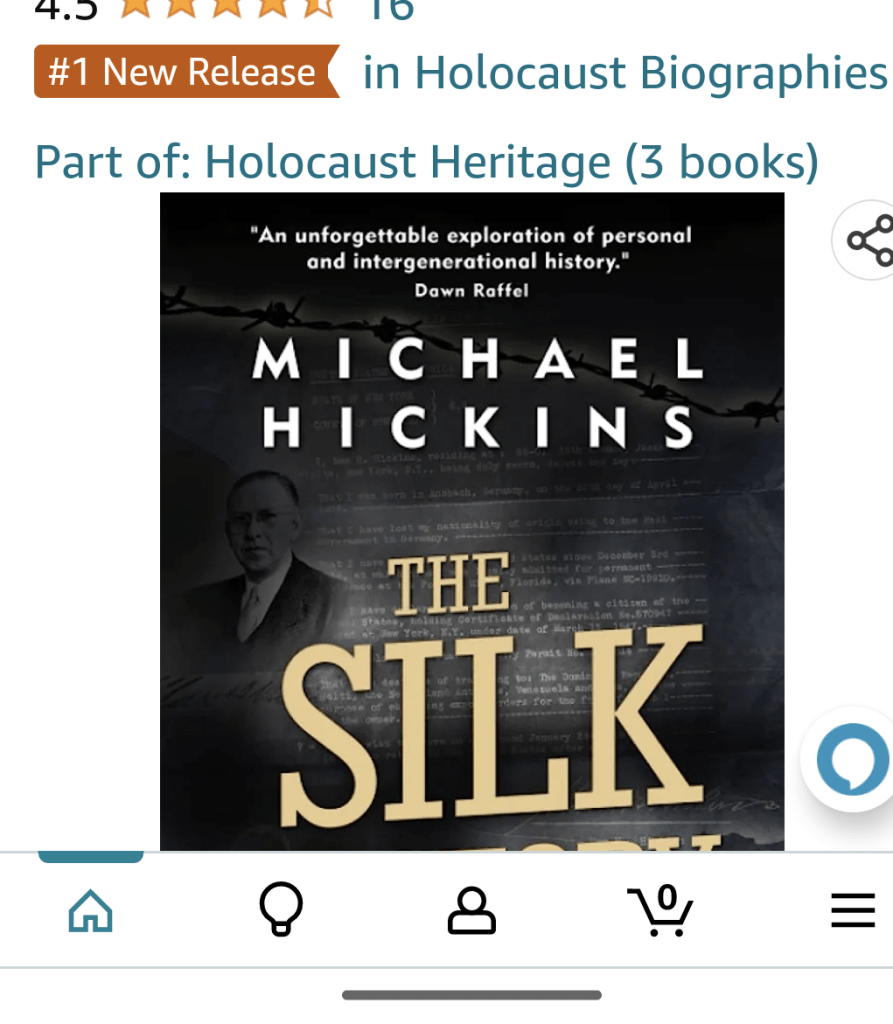
My own memoir, The Silk Factory: Finding Threads of My Family’s True Holocaust Story, has been out for almost two full months (June 1, 2023 was its official publication date). And to the surprise of no one, I am not about to quit my day job.
The book has earned its fair share of accolades so far – more than 20 four- and five-star reviews on Amazon, truly heartwarming advance praise from writers I really admire – Victoria Redel, Dawn Raffel, Alice LaPlante, Sam Apple, and Michael Gottlieb, and heartfelt accolades from people who bought and read the book.
My plan now is to continue trying to promote the book, and to write regularly about the progress we make as a way of further demystifying the process. This post is the first of many I intend to write in this regard.
Pre-publication activities
In the lead-up to publication, I asked those writers I mentioned above if they would consider writing a blurb for my book, and all of them said they would read it and write a blurb if they liked it; and they did.
I connected with a videographer (who happened to really like my book) named Alan Freedman, who produced a video that I was able to use to promote the book’s pre-availability and when it came out. (Once thing I haven’t been good about is reusing the video…)
Amazing feedback
I also connected with a Holocaust survivor who speaks in the Hudson Valley region about her experiences during WWII so that younger generations of Jews know what happened. I shared my manuscript with her and she wrote me the following:
Yours is the first book written by a second generation survivor that I have read and it moved me very much. Being a survivor and also the daughter of survivors, I never quite understood how much pain was transmitted to those children whose parents suffered directly from the horrors of WWII. I really could not separate the feelings resulting from my own experience from those that my father’s incarceration in Auschwitz and his almost 2 years of slave labor in the IG Farben Fabrik generated in me. Your book made that a lot clearer. The description of the rage you felt at the theft of your family’s factory and the callousness with which the present owners simply pretended that the past did not exist made me scream. While we did not have a lot of material possessions before the war, I feel the loss and anger more for the family members that were murdered and the rich Jewish life that was simply destroyed. My father remained orthodox even after the horrors that he was subjected to and the murder of his mother and siblings; I simply could not accept that. It created a lot of tension in my family and now I question whether I had the right to yell at him and condemn the way he chose to live his life. He never volunteered many details about his imprisonment and I wish I had had the maturity to try and understand him then. To some extent the fact that he continued to pray to the nonexistent god added to my shame of being Jewish. While pretending to be Catholic I was seduced by the church that I attended on Sundays and I thought that joining that group would be a lot more beneficial than having to be continuously afraid to get caught and killed. You describe so many of your feelings in a way that I totally can empathize with including the difficulties with your relationships.
My recovery so to speak stems to a great extent from the incredible achievement of Israel and its immense contribution to the well-being of so many. I am now a proud Jew and do what I can to fight antisemitism by all the means available to me by telling my story to audiences of different ages …
I highlighted many passages in your book because they spoke to me in a very personal way and that is what I wanted to convey to you.
I also sent out dozens of requests for reviews to publications like the NYT of course, but also smaller outlets. I also came to terms with the fact that before I could market my book to “everyone” I had to first successfully market my book to fellow Jews, notably those of my generation.
I had to fight the feeling that my book isn’t specifically a “Jewish” book, but a book about the generational impact of trauma, the harm caused by silence, and the importance of atonement and, when possible, restitution, and that it is as salient to Gentile audiences as to Jews. It is those things, but as with any product or service, you go after your core customer first. In this case, my core audience is Jewish American Boomers.
I was able to land a podcast interview with the Jewish Literary Journal as well as a place on Barbara Krasner’s blog The Whole Megillah, which was picked up by The Rachack Review’s Jewish Book Carnival. If that sounds like a lot, I should add that the combined readership of those outlets is probably around 11. That said, notice is notice, I didn’t pay for those placements, and I can brag about them (endlessly, as it turns out).
Once my book achieved the bar of 10 Amazon reviews, my publisher, true to her word, advertised my book on Amazon, which helped it achieve Best Seller status among “new releases” in the category of Holocaust Biographies.
It’s a slender category, but for a few days, I was number one!
Next time, I will write about my early attempts at using social media, and what other activities I’ve engaged in to promote my book.
 Michael Missing